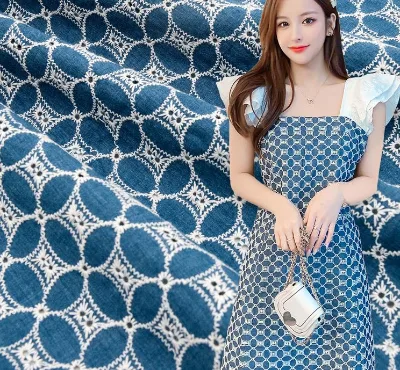
Source Embroidered Bead Denim Lace Fabric for Bridal, Wedding, and Accessories
Find and compare 30 Embroidered Bead Denim Lace Fabric options for bridal gowns, wedding dresses, and fashion accessories. Evaluate features like wrinkle resistance, breathability, and customization to select the right material for your garment manufacturing needs.
Key considerations
Products List


Intricate Beaded Lace Embroidery Fabric for Couture and Crafting Projects
$4.00 - $9.00
MOQ: 300 Meters


Classicc OEM Manufactured Beads Embroidery Lace Fabrics for Wedding Dresses
$10.00 - $14.00
MOQ: 50 Yards




Comprehensive Sourcing Guide
Embroidered Bead Denim Lace Fabric Sourcing Guide
The market for Embroidered Bead Denim Lace Fabric presents a complex landscape where traditional denim aesthetics merge with delicate lace and beadwork techniques. While the core keyword suggests a specific blend of rugged denim and ornate embellishment, current supplier listings reveal a broader spectrum of materials including cotton, polyester, and mesh fabrics that utilize similar embroidery and lace craft methods. Buyers must recognize that the term "denim" in search results often serves as a stylistic descriptor for the fabric's texture or intended application rather than a strict material composition, as observed listings frequently feature 100% polyester or cotton bases with machine embroidery and sequin details.
Procurement decisions for this category require a clear distinction between the visual style and the underlying technical specifications. The observed product data indicates that while some items are explicitly labeled as denim-style, many are constructed from mesh or polyester with 3D embroidery and lace applications suitable for bridal gowns, clothing, and accessories. This divergence means that a buyer seeking a specific denim weight or weave must verify the material composition directly, as the "embroidered floral mesh fabric with sequins & lace" listings demonstrate that the visual outcome can be achieved through various fiber blends and production techniques.
Product Scope and Observed Listing Signals
The product scope for embroidered embellished fabrics spans a wide range of applications, from bridal gown manufacture and wedding dress grown fabric to general clothing and home textile uses. Observed listings highlight specific styles such as trimming and geometry patterns, with color production methods ranging from dyed to customized options. The presence of features like wrinkle resistance, waterproofing, and breathability suggests that these fabrics are engineered for functional performance in addition to their aesthetic appeal, making them suitable for garments that require durability and comfort alongside decorative elements.
Listing signals indicate significant variability in packaging and standardization, with products arriving reeled, by carton, or in rolls with dimensions varying from 125cm to 160cm in width. Buyers should note that while some models specify a standard width of 150cm or 130cm, others offer custom widths, and the production origin is consistently traced to Zhejiang, China. The diversity in model numbers, such as LF21016, 10401, and NWF001, reflects a market where customization is acceptable and often expected, requiring buyers to align their specific design requirements with the supplier's capacity for tailored production rather than relying solely on off-the-shelf inventory.
Technical Specifications to Verify
Technical verification must begin with the material composition, as the supply chain offers both cotton and polyester options, with some listings specifying 100% polyester and others utilizing mesh bases. The embroidery type is a critical differentiator, with observed data showing both 3D embroidery and machine embroidery techniques, often paired with nylon thread for the stitching. Buyers need to confirm whether the desired aesthetic requires the depth of 3D work or the precision of standard machine embroidery, as this choice directly impacts the fabric's drape, weight, and suitability for specific garment structures like bridal gowns or accessories.
Further verification is required for the lace craft and finishing processes, which include around manual processes and specific dyeing techniques. The observed specifications list fabric widths ranging from 51/52 inches to 130cm, and buyers must ensure the selected width aligns with their pattern cutting requirements to minimize waste. Additionally, the presence of sequins and lace in the product descriptions necessitates a check on the attachment method and durability, ensuring that the embellishments will withstand the intended use, whether for a wedding dress or everyday clothing, without compromising the structural integrity of the base fabric.
Compliance and Safety Documentation
While the provided data does not explicitly list specific certification statuses, buyers must request documentation regarding the safety of the materials used, particularly concerning the nylon threads and sequins mentioned in the product attributes. In the textile industry, compliance often involves verifying that the dyes used in the color production process meet international standards for restricted substances, especially since the listings indicate both dyed and customized color options. It is essential to confirm that the fabric meets the safety requirements for the intended market, such as flammability standards for children's clothing or chemical restrictions for bridal wear, even if these are not explicitly stated in the initial product listing.
Documentation should also cover the origin and traceability of the materials, given that the production origin is listed as Zhejiang, China. Buyers should seek proof of origin and any relevant environmental or labor compliance certifications that the supplier may hold, as these are standard expectations for B2B procurement in the textile sector. Although specific test results are not provided in the source data, the buyer must ensure that the supplier can provide third-party test reports for the finished fabric, confirming that the wrinkle-resistant and waterproof features are genuine and that the materials do not contain harmful levels of azo dyes or other regulated chemicals.
Cost Drivers and Commercial Terms
Cost drivers for this category are heavily influenced by the complexity of the embroidery and the inclusion of embellishments like sequins and lace. The observed MOQ ranges from 1 to 5000 units, with specific listings showing MOQs of 1000 units or 300 yards, indicating that smaller orders may incur higher per-unit costs or require a premium for customization. The production time, typically ranging from 5 to 10 days for standard orders and 7 to 10 days for production, suggests that lead times can vary based on the intricacy of the design and the availability of specific materials like nylon thread or custom-dyed fabrics.
Commercial terms must account for the variability in packaging and shipping, as products are listed as being packed by roll, carton, or reeled, with standard dimensions like 160x20x20cm for some items. Buyers should clarify whether the quoted price includes the cost of the custom packaging or if additional fees apply for specialized shipping requirements. The sample lead time of 5 to 7 days is a critical factor in the procurement timeline, and buyers should factor this into their overall project schedule, ensuring that the sample approval process does not delay the final production run, which typically takes 5 to 10 days once the sample is confirmed.
Supplier Qualification and Quality Control
Supplier qualification should focus on their ability to handle the specific technical requirements of embroidered lace and beadwork, such as the ability to execute 3D embroidery or machine embroidery with precision. The observed data shows a variety of applications, from bridal gowns to general clothing, indicating that a qualified supplier must have experience across different garment types and the flexibility to accommodate custom designs. Buyers should verify the supplier's capacity to maintain consistency in color production, especially when custom colors are requested, and ensure they have the necessary equipment to handle the manual processes and around techniques mentioned in the product attributes.
Quality control measures must include a rigorous inspection of the finished fabric for defects in the embroidery, the security of sequins and lace attachments, and the uniformity of the dyeing process. Given the observed features like wrinkle resistance and breathability, buyers should request physical samples to test these claims before committing to a large order. It is also advisable to establish a clear protocol for handling discrepancies in fabric width or material composition, as the listings show variations in width from 125cm to 160cm, and any deviation from the agreed specifications could impact the final garment production.
Long-Term Procurement Checks
Long-term procurement success depends on establishing a reliable supply chain that can consistently deliver high-quality embroidered fabrics with the required technical specifications. Buyers should conduct periodic audits of the supplier's production capabilities to ensure they can maintain the standards for 3D embroidery, machine embroidery, and the use of specific materials like nylon thread and polyester. Regular communication regarding changes in material availability or production techniques is essential, as the textile market is dynamic and suppliers may need to adapt their processes to meet evolving customer demands or regulatory requirements.
Continuous monitoring of the supplier's performance against key metrics such as delivery time, sample lead time, and defect rates is crucial for maintaining a stable supply chain. Buyers should track the consistency of the fabric width, color production, and the durability of the embellishments over multiple orders to identify any trends in quality degradation or production delays. By maintaining a proactive approach to supplier management and regularly reviewing the commercial terms and technical specifications, buyers can ensure a sustainable partnership that supports their long-term product development and market competitiveness.
FAQs
What materials are used for this embroidered lace fabric?
The fabric is primarily made from cotton or polyester, with some variants using 100% polyester mesh. Embroidery threads are typically nylon, ensuring durability and a high-quality finish for various garment applications.
Can I customize the color and design of this fabric?
Yes, customization is available for colors including white, black, blue, purple, and green, or specific custom requests. Buyers can also request custom embroidery patterns to suit their unique clothing or bridal gown manufacturing needs.
What is the minimum order quantity for this lace fabric?
The minimum order quantity varies by supplier, with observed ranges starting from 1 unit up to 5000 units. Specific listings indicate MOQs of 1000 units or 300 yards, so buyers should verify requirements with individual vendors.
How long does it take to receive samples of this fabric?
Sample lead times typically range from 5 to 7 days for production. Once the sample is ready, the delivery time for the main order usually takes between 5 to 10 days depending on the specific supplier and order volume.
Which applications are suitable for this embroidered floral mesh fabric?
This fabric is suitable for clothing, bridal gowns, accessories, and home textiles. Its features like being wrinkle-resistant, waterproof, and breathable make it ideal for various garment types including wedding dresses and general apparel.
What are the standard packaging methods for this lace fabric?
The fabric is commonly packed by roll, by carton, or reeled for shipment. Standard packaging dimensions may vary, with some rolls measuring 160x20x20cm, ensuring the material remains protected during transit to international destinations.
Where is this embroidered lace fabric manufactured?
The products originate from Zhejiang, China, which is a major hub for textile manufacturing. This location allows for efficient production and shipping, with many suppliers offering competitive lead times for international buyers.